
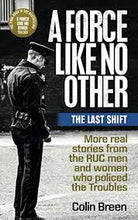
A Force Like No Other: The Last Shift by Colin Breen
Pickup available at 112 York Rd
Usually ready in 1 hour
In ‘A Force Like No Other: The Last Shift’, the third book in his bestselling A Force Like No Other series, former RUC officer Colin Breen brings together more compelling insider stories from RUC officers who served during the Northern Ireland Troubles.
- 'A most powerful and unique insight into the world's most dangerous job in policing in the 1970s and '80s.' Henry McDonald, Observer and Guardian
- 'This book of real RUC insider anecdotes ... has, of course, the best possible sources - the cops themselves.' Hugh Jordan, Sunday World
- 'A Force Like No Other’ recalls the horrors of the Troubles but also some of the funnier stories of everyday life as a cop.' Stephen Gordon, Sunday Life
Frequently asked questions about Colin Breen Books
Is this Colin Breen book based on real accounts?
Yes. It is presented as a collection of real, first hand anecdotes and insider recollections from RUC officers who served during the Troubles, compiled and narrated by Colin Breen, a former RUC officer.
Do I need to read Books 1 and 2 first?
No. You can read this as a standalone. If you want the fullest context and series progression, reading Books 1 and 2 first will add background, but it is not required.
Why does it appear as “The Last Shift” and “The Final Shift”?
You may see both because different listings and promotional materials sometimes use alternate wording for the subtitle. Treat “The Last Shift” as the primary title, with “The Final Shift” as a common search variant. Matching the cover and confirming it is Book 3 is the best way to verify you have the right volume.
What period of the Troubles does this cover?
The stories focus on the Troubles era, with particular emphasis on policing in the 1970s and 1980s. The book is centred on lived experience and day to day operational reality rather than a comprehensive historical timeline.
Is this more memoir, history, or anecdotal policing stories?
Primarily anecdotal policing stories. It reads as an insider, narrative collection that captures incidents, pressures, atmosphere, and occasional moments of humour, rather than a structured political or academic history.